


Cappadocia Balloon Cancellation Rate by Month
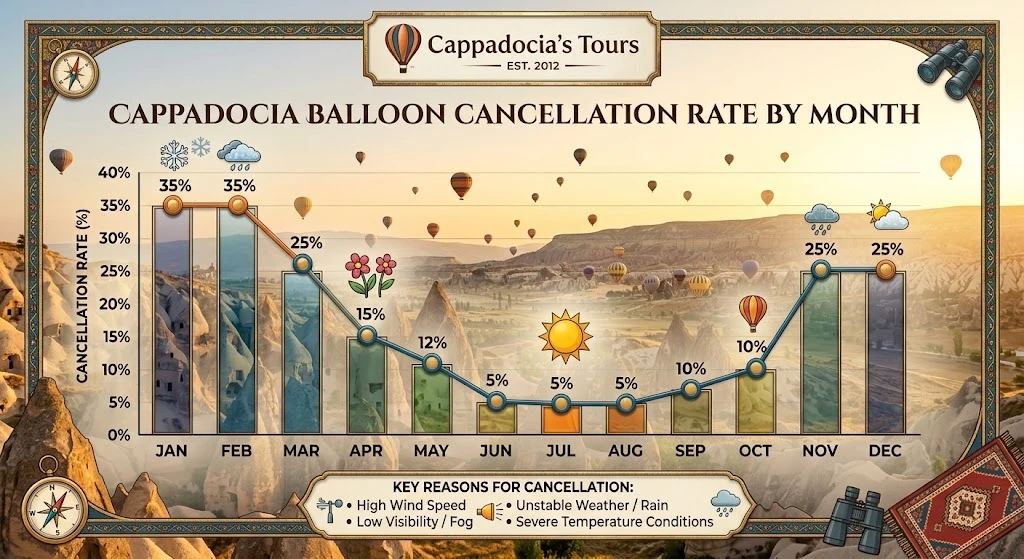
Cappadocia Balloon Cancellation Rate by Month: Statistics, Weather and Booking Tips
The risk of a hot air balloon flight cancellation in Cappadocia changes throughout the year. June to September generally offers more favourable flying opportunities, while December to February brings greater weather uncertainty. Wind, fog, poor visibility, rain, snow and official aviation restrictions can prevent flights from operating on any morning.
There is no verified official monthly cancellation-rate table available for this guide. Reported annual flight-day figures provide useful context, but they cannot establish the exact percentage of individual bookings cancelled in each month.
For travellers planning a sunrise balloon ride over Göreme, the most practical approach is to book the flight for the first morning of their stay and leave another morning available as a backup. This is particularly useful during winter, when unsuitable conditions can affect several consecutive mornings.
This guide explains the reported flight-day statistics, compares seasonal cancellation risks, describes how flight decisions are made and shows how to plan your Cappadocia trip around the possibility of a cancellation.
Find out when Cappadocia hot air balloon flights are most likely to be cancelled. Compare monthly weather risks and plan a backup flight.
Quick Answer: What Is the Cappadocia Balloon Cancellation Rate?
Cappadocia does not have a verified monthly balloon cancellation percentage established in this guide. Long-term figures reported for the region indicate approximately 220 flight days per year, while reported annual totals vary. Summer generally offers more favourable flying opportunities than winter, but balloons can be grounded in any month when conditions are unsuitable.
Here is what travellers should know:
- Generally lower seasonal cancellation risk: June, July, August and September.
- Greater seasonal uncertainty: December, January and February, with variable conditions during March and November.
- Main cancellation reasons: Wind, fog, poor visibility, precipitation and aviation safety restrictions.
- Annual flight-day context: Approximately 220 days in a reported long-term average; this is not an individual booking cancellation rate.
- Best booking strategy: Schedule your balloon flight for the first morning of your stay and keep a backup morning available.
- Refunds and rebooking: Check the written terms of your reservation before payment.
The monthly risk categories in this article are qualitative seasonal guidance, not official statistics. Your actual flight depends on the weather, applicable aviation decisions and available capacity on your travel dates.
Cappadocia Balloon Cancellation Rate by Month
The following table compares general seasonal risk, common weather concerns and practical planning advice. It does not assign invented percentages to individual months.
Month Relative seasonal risk Main weather considerations Planning advice January | High | Fog, wind, snow and reduced visibility | Allow up to 3 available mornings if possible |
February | High | Wind, precipitation and winter weather | Keep backup time in your itinerary |
March | Moderate to high | Changing winds and unsettled conditions | Consider 2–3 mornings |
April | Moderate | Gusts, showers and variable weather | Consider 2–3 mornings |
May | Low to moderate | Occasional wind and unsettled conditions | Keep a backup morning |
June | Generally low | Occasional unsuitable winds | Book early in your stay |
July | Generally low | Wind and changing flight conditions | Keep a backup morning |
August | Generally low | Wind and other operational restrictions | Keep a backup morning |
September | Generally low | Occasional wind and weather changes | Book early in your stay |
October | Low to moderate | Seasonal weather changes and possible fog | Consider 2 mornings |
November | Moderate to high | Fog, rain and wind | Allow additional flexibility |
December | High | Fog, snow, wind and reduced visibility | Consider 3 available mornings |
How to interpret the table: These are general seasonal assessments, not measured monthly cancellation rates. Weather conditions can change from one morning to the next. A summer flight can be cancelled, and a winter morning can be suitable for flying.
The recommended number of mornings is a planning suggestion, not a guarantee that a flight will operate.
What Do Annual Cappadocia Balloon Flight Statistics Tell Us?
Reported annual flight-day figures help explain why weather flexibility matters when booking a balloon ride. However, different sources may report different years, periods or types of measurements.
The figures summarised below have been reported in Turkish aviation and travel coverage, with some reporting attributed to civil aviation data.
Reporting period Reported flight daysInterpretationLong-term average | Approximately 220 per year | A general indication of annual operating frequency |
2025 | 223 | Flights reportedly operated on approximately 61% of calendar days |
January–June 2026 | 90 | A reported six-month total illustrating variation between periods |
These figures should be checked against the original records before being used as definitive statistics in a published article. They are not a complete monthly cancellation dataset.
Does 220 flight days mean a 40% cancellation rate?
No. It means that approximately 40% of calendar days would have no reported flight operations if the annual total were 220 days.
The calculation is:
- 365 calendar days minus 220 flight days = 145 days without recorded flight operations.
- 145 divided by 365 = approximately 39.7%.
This is a calculation of calendar days, not cancelled bookings.
A day without balloon operations may affect many passengers, while an individual reservation may be cancelled or rescheduled under different circumstances. The calculation also does not reveal whether days without flights occurred mainly in winter or were distributed throughout the year.
The correct conclusion is that annual flight-day totals provide context, not an official cancellation percentage for individual travellers.
Why do published flight-day figures differ?
Annual totals can vary because of the reporting period, weather conditions in a particular year, the source of the figures and the way flight operations are counted.
A statement that Cappadocia's climate may allow flying on up to 280 days under favourable conditions is not equivalent to a record showing that flights actually operated on 280 days in a particular year.
Similarly, a long-term average of approximately 220 days should not be interpreted as a prediction for every year.
To calculate a reliable monthly cancellation rate, the underlying records would need to identify the total number of scheduled flights or relevant operating days and the number cancelled over the same period.
Why Are Cappadocia Balloon Flights Cancelled?
Hot air balloon flights depend on suitable weather and compliance with aviation safety requirements. A confirmed booking does not guarantee departure because conditions can change between the previous evening and sunrise.
1. Wind and wind direction
Wind is a critical factor in balloon operations. Conditions at the launch site and at different altitudes affect whether a flight can proceed safely.
A morning may feel calm near your hotel while conditions across the flight area remain unsuitable. This is why a general weather app cannot confirm that a balloon will take off.
2. Fog and poor visibility
Fog and low cloud can reduce visibility and affect safe flight operations. These conditions can be particularly disruptive during colder periods, although fog is not limited to winter.
3. Rain and snow
Precipitation and associated weather conditions can make flying unsuitable. Snow on the ground does not automatically prevent a flight; the relevant factors are the current conditions and applicable aviation requirements.
4. Unstable weather
Changing winds and other adverse weather conditions can affect balloon operations even when the forecast initially looks favourable.
The weather expected the evening before a flight is not a guarantee of the conditions at sunrise.
5. Official aviation restrictions
Commercial balloon operations in Cappadocia are subject to Turkish civil aviation oversight. Flights must comply with the applicable safety requirements and operational authorisation procedures.
When conditions are unsuitable, departures may be restricted or cancelled. A travel agency or balloon operator cannot guarantee that permission to fly will be granted.
Who Decides Whether Cappadocia Balloons Can Fly?
Cappadocia balloon flights operate under Turkish civil aviation oversight and the applicable operational procedures. Individual booking companies cannot independently authorise a flight when the relevant safety requirements are not met.
The process generally involves assessing weather conditions, reviewing operational restrictions and determining whether flights may proceed under the applicable aviation procedures.
Travellers may encounter green or red status indicators on official operational information channels. They should check the current status rather than rely on an old screenshot or an unofficial social media update.
For information available through our website, visit the Cappadocia Balloon Flight Status page.
Changing to another booking company is not a dependable way to avoid a cancellation caused by weather or a broader operational restriction.
Why Can Rebooking Be Difficult After Consecutive Cancellations?
When flights cannot operate for several mornings, passengers may need to move their reservations to later dates. Demand can increase when operations resume because previously booked passengers are also looking for available places.
Two factors matter:
- Weather availability: Another suitable morning must occur before your departure.
- Flight capacity: The preferred flight category must have room for your reservation.
Available places depend on the applicable operational limits, approved flight capacity and existing bookings. A cancelled reservation does not necessarily mean an equivalent place will be available the following morning.
This is why booking early in your stay is useful. If your first attempt is cancelled, you may still have time to try again.
How Many Mornings Should You Allow for a Cappadocia Balloon Flight?
The number of mornings available affects how much flexibility you have if a flight is cancelled.
Available morningsPractical implication1 morning | One opportunity; a cancellation may mean missing the flight |
2 mornings | An additional opportunity if the first flight is cancelled |
3 mornings | More flexibility during winter or unsettled weather |
4 or more mornings | More opportunities, subject to weather and availability |
These are planning scenarios, not calculated probabilities of success.
A longer stay gives you more opportunities to try again, but it cannot guarantee that a flight will operate. If you have a fixed departure from Cappadocia, avoid scheduling the balloon ride for your final morning whenever possible.
For broader booking advice, read our Cappadocia Hot Air Balloon Booking Guide.
How to Reduce the Risk of Missing Your Balloon Flight
You cannot control the weather, but you can plan your itinerary to reduce the consequences of a cancellation.
1. Book the first morning of your stay. This leaves subsequent mornings available if your original flight cannot operate.
2. Keep a backup morning free. Avoid scheduling the flight on the morning you leave Cappadocia if you can arrange your itinerary differently.
3. Allow more flexibility in winter. Three available mornings provide more opportunities than one, although they do not guarantee a flight.
4. Check the refund policy before paying. Confirm the conditions for weather cancellations, rebooking and refunds.
5. Follow current flight-status information. A forecast helps you prepare, but it does not replace the applicable operational decision.
6. Compare flight packages carefully. Check the advertised flight duration, basket capacity, included services and cancellation terms rather than choosing an operator based on an assumed ability to avoid weather restrictions.
For a broader overview of costs and flight options, visit our Cappadocia Hot Air Balloon Booking Guide.
What Happens If Your Balloon Flight Is Cancelled?
Your options depend on the booking terms, the reason for cancellation and whether another suitable morning is available.
Before paying, confirm the following:
- Can the reservation be moved to the next available morning?
- Is a full refund available if the flight cannot operate?
- How and when will the provider notify you?
- Do the terms differ between flight categories?
If your flight is cancelled, ask whether a place is available on the next operating morning. If rescheduling is not possible during your stay, follow the refund procedure specified in your reservation terms.
Do not assume that every provider offers identical cancellation conditions. The written policy associated with your booking should determine the available options.
You can review available booking information through our Cappadocia hot air balloon booking page.
Frequently Asked Questions
What is the Cappadocia balloon cancellation rate?
A verified official monthly cancellation percentage is not provided in this guide. Reported annual flight-day figures offer context but cannot establish the proportion of individual bookings cancelled.
Does Cappadocia have a 40% balloon cancellation rate?
Not necessarily. Approximately 40% is the estimated proportion of calendar days without flight operations if the region averages 220 flight days in a 365-day year. It is not a measured cancellation rate for individual reservations.
Which month has the lowest balloon cancellation risk?
June, July, August and September generally offer more favourable flying opportunities. However, wind and other safety requirements can still prevent flights on any date.
Which months have the highest balloon cancellation risk?
December, January and February generally bring greater weather uncertainty. November and March can also have changeable conditions.
Can Cappadocia balloon flights be cancelled for several days in a row?
Yes. Persistent wind, fog, precipitation or other unsuitable conditions can prevent flights on consecutive mornings. When operations resume, demand for available places may increase.
Can I fly in Cappadocia during winter?
Yes, when weather conditions and applicable aviation requirements permit. Winter flights are possible, but travellers should allow greater flexibility in their itineraries.
Does booking with another balloon company reduce cancellation risk?
Not necessarily. Weather conditions and aviation restrictions can affect multiple operators. Compare providers based on transparent booking terms, flight details, customer service and refund arrangements.
Should I book my balloon flight for the first morning of my stay?
Yes, if your itinerary allows it. Booking early leaves more time to reschedule if the original flight is cancelled and another suitable departure is available.
Will I receive a full refund if my balloon flight is cancelled?
That depends on the written terms of your booking. Confirm the weather-cancellation and refund policy before making payment.
Is the balloon cancellation risk the same every year?
No. Weather patterns and operating conditions vary between years. An annual average cannot predict the number of flight days in a specific month or guarantee that a particular morning will be suitable.
Plan Your Cappadocia Balloon Flight With Flexibility
Cappadocia's balloon flights depend on weather, operational conditions and aviation authorisation. Summer generally offers more favourable flying opportunities, while winter calls for greater flexibility.
Annual flight-day figures help explain the seasonal challenge, but they should not be confused with individual booking cancellation rates. Without a verified monthly dataset, exact percentages would give travellers a misleading sense of certainty.
Book your balloon flight for the first morning of your stay, leave a backup morning available and understand the cancellation policy before paying. This approach gives you more flexibility to experience Cappadocia from the air without treating a weather-dependent flight as a guarantee.
Explore our Cappadocia hot air balloon booking options and plan your visit with enough time for a possible change of date.
Our partners


